Flux-pumped CPW JPA
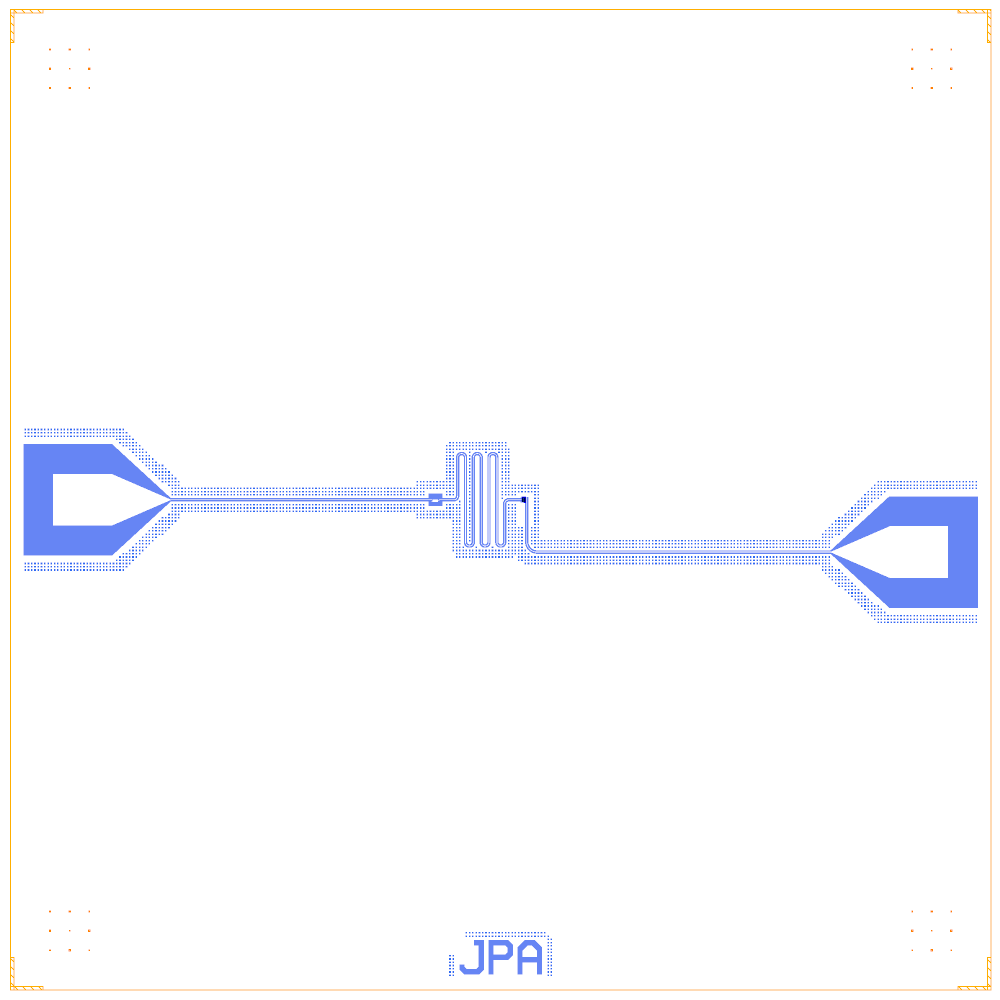
A Josephson parametric amplifier used in reflection: a λ/4 CPW resonator that couples to the signal line through a finger capacitor and ends in a DC SQUID to ground. The SQUID’s flux-dependent inductance tunes the resonance, and a pump line next to it drives the amplification. The design is QPDK’s cpw_jpa chip (MIT), rebuilt on the Quantcore PDK.
This notebook shows how a reflection amplifier is wired: a signal feed with a coupling capacitor, a meander resonator and a shorted pump line, with a SQUID termination at the end of the resonator.
At a glance
Notebook |
|
Source |
QPDK |
Chip |
7.5 × 7.5 mm Quantcore die, sapphire 650 µm, CPW 10 / 6 µm |
On the chip |
1 |
Builds today |
yes (layout built on 2026-11-19 in 5 s) |
How the notebook builds it
The amplifier notebooks use six Design segments (die, pads, feed, nonlinear element, routing, whole chip); see the notebook template.
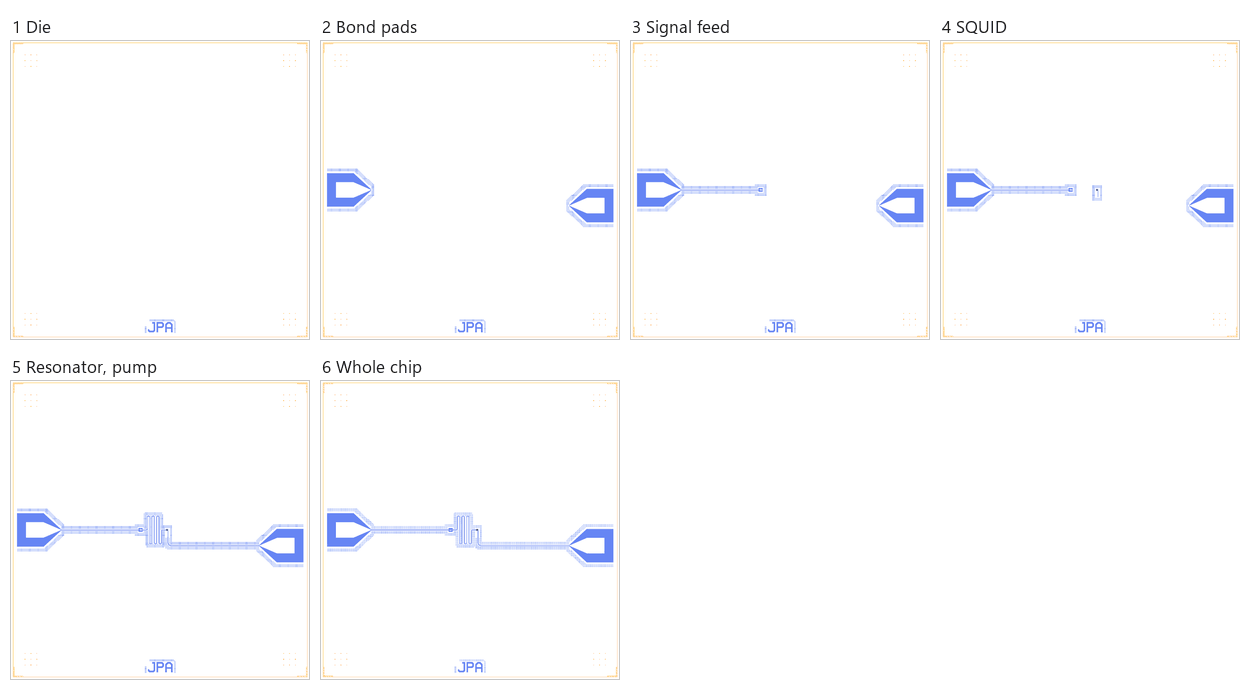
Die. The empty die with the QCT frame.
Bond pads. A signal pad on the west edge and a pump pad on the east edge, slid to the 100 µm rule.
Signal feed. The coupling capacitor (8 fingers × 50 µm) and its 50 Ω line from the signal pad.
Nonlinear element. The SQUID termination, with the largest SQUID the PDK allows.
Routing. The λ/4 resonator meander from the capacitor to the termination, and the pump line to its pad.
Whole chip. The target (6.07 GHz at zero flux), the sim groups and the saved design.
LOM estimates
Numbers are from a run of this notebook on 2026-11-19 (Setup, Design, Check and the LOM cells, 10 s). This is an amplifier, so the LOM section gives gain and phase matching, not qubit frequencies. The readout line has Z0 = 55.1 Ω, v_p = 1.260e8 m/s and C_c = 28.2 fF. The resonance (JPA mode at 5.736 GHz, κ = 19.8 MHz in QuCat) moves with the SQUID inductance and flux:
SQUID |
L_s(0) (nH) |
f0 (GHz) |
κ/2π (MHz) |
Q_ext |
|---|---|---|---|---|
drawn PDK SQUID |
0.253 |
5.784 |
21.2 |
272 |
QPDK source SQUID |
0.0686 |
6.262 |
26.9 |
233 |
no SQUID |
0 |
6.463 |
29.5 |
219 |
SQUID |
f0 at 0.3 Φ0 (GHz) |
κ/2π (MHz) |
df0/dΦ (GHz/Φ0) |
threshold Φ_p (mΦ0) |
|---|---|---|---|---|
drawn PDK SQUID |
5.399 |
17.4 |
-3.72 |
4.67 |
QPDK source SQUID |
6.129 |
25.2 |
-1.38 |
18.3 |
Flux-pumped gain of the drawn SQUID against the pump strength r:
r |
peak gain (dB) |
pump flux Φ_p (mΦ0) |
-3 dB bandwidth (MHz) |
|---|---|---|---|
0.5 |
4.44 |
2.34 |
13.6 |
0.7 |
9.31 |
3.27 |
5.56 |
0.8 |
13.2 |
3.74 |
3.48 |
0.9 |
19.6 |
4.21 |
1.74 |
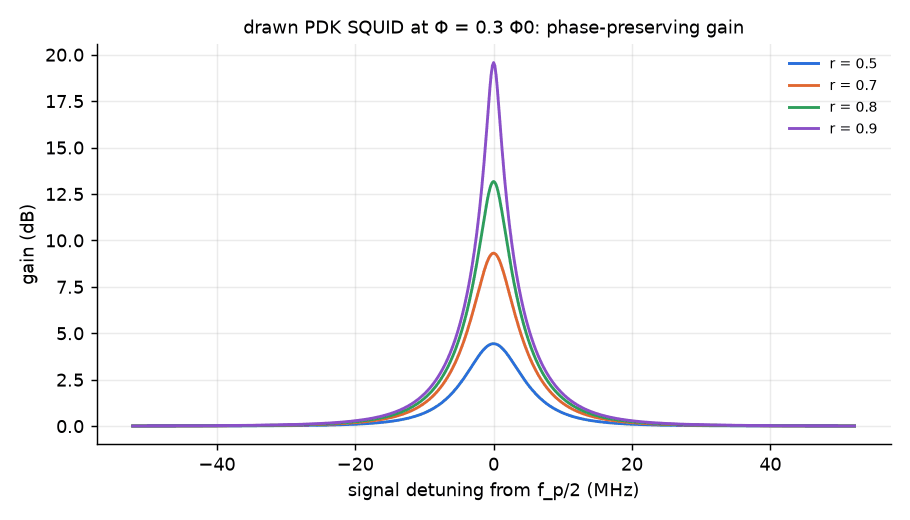
These are lumped-model estimates (component formulas and calibration), not FEM results. The LOM page says how far to trust them.
Build spec
The rest of this page is the detailed spec the notebook was built from, with every component, port, route and length.
Source · licence: gdsfactory/quantum-rf-pdk (MIT): qpdk/cells/parametric_amplifier.py, qpdk/samples/cpw_jpa_chip.py, notebook vacask_cpw_parametric_amplifier (Yamamoto 2008; Pogorzalek 2017). Die: 7.5 × 7.5 mm PDK die, PDK frame, sapphire 650 µm, Nb trilayer junctions. Notebook and design: examples/designs/amplifiers/qpdk_cpw_jpa.ipynb / .json.
Components
instance |
catalog ref |
key params |
notes |
|---|---|---|---|
P_SIG, P_PUMP |
|
west / east edge, |
|
CC |
|
8 fingers × 50 µm, 5 µm wide, 2 µm gap (≈ 28 fF) |
|
ST |
|
lead 10 µm + 6 × 28 µm head, 20 × 34 µm pocket, largest PDK SQUID (2 × 2.0 × 2.0 µm), pump 200 µm / 2 µm strip / 20 µm offset |
Routes
route |
from → to |
type |
|---|---|---|
L_SIG |
P_SIG.a → CC.a |
CPW 10/6 |
JPA |
CC.b → ST.a |
meander 4664 µm, 6 meanders at r = 30 µm (6 turns need 2·r·7 ≤ the 478 µm straight; λ/4 = 4680 µm with the lead + head) |
L_PUMP |
ST.pump → P_PUMP.a |
CPW, one waypoint |
LOM node structure
pad (50 Ω), then C_c, then a λ/4 TLres (route plus a termination at its equivalent length lead + L_s/L’); the pump is a flux control
Targets (from the source)
QPDK: 6.07 GHz at Φ = 0, Q_ext ≈ 290 (its stack, I_c 4.8 µA)
Simplifications / PDK differences
SQUID I_c 1.3 µA instead of 4.8 µA (PDK junction rule); sapphire + Nb kinetic inductance; bond pads instead of launchers; junctions are flagged pdk_rn where present (amplifier junctions are far below the qubit R_n window).