Two coupled transmons (SQDMetal)
Two floating pocket transmons 1 mm apart, joined by a straight CPW between their facing connection pads. There is no resonator, and the coupling is a direct capacitive link. It is SQDMetal’s two-transmon eigenmode example (Apache-2.0), rebuilt on the Quantcore PDK with the metal:TransmonPocket wrapper.
Build this one to learn the smallest two-qubit chip and how a Qiskit Metal component is used through the metal: wrapper.
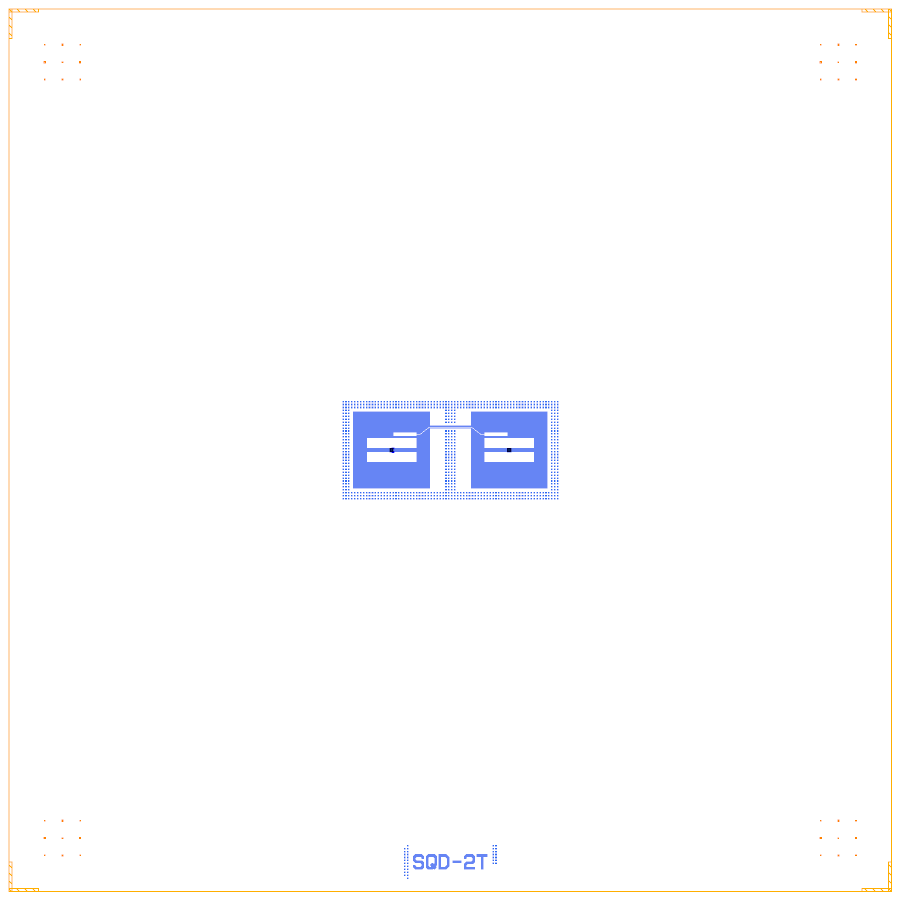
At a glance
Notebook |
|
Source |
SQDMetal example |
Chip |
7.5 × 7.5 mm Quantcore die, the source’s 2.2 × 1.8 mm area in its middle, CPW 10 / 6 µm |
On the chip |
2 Metal pocket transmons · 1 straight CPW coupler |
Builds today |
yes (layout built on 2026-11-19 in 7 s) |
How the notebook builds it
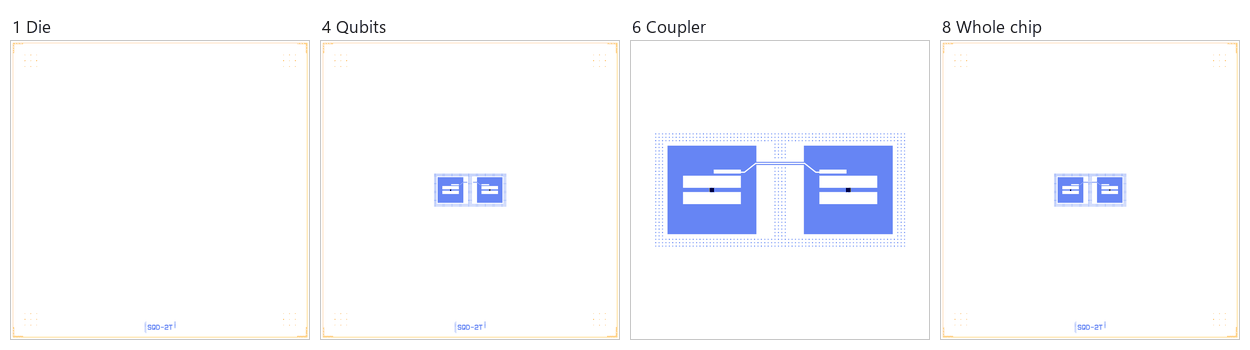
Die. The Quantcore die with the frame and the device ID.
Bond pads. None.
Readout line. None.
Qubits. Two
metal:TransmonPocketcells.Readouts. None.
Coupling. One straight CPW between the two
readoutpins.Control lines. None.
Whole chip. One sim group, centring, save.
LOM estimates
Numbers are from a run of this notebook on 2026-11-19 (Setup, Design, Check and the LOM cells, 6 s): QuCat normal modes with QuTiP dressed values.
parameter |
LOM (QuTiP) |
target |
|---|---|---|
|
7.07 |
– |
|
-349 |
– |
|
7.73 |
– |
|
-324 |
– |
group |
pair |
ZZ (kHz) |
neighbours |
hybridised |
|---|---|---|---|---|
Q1-Q2 |
-3880 |
yes |
no |
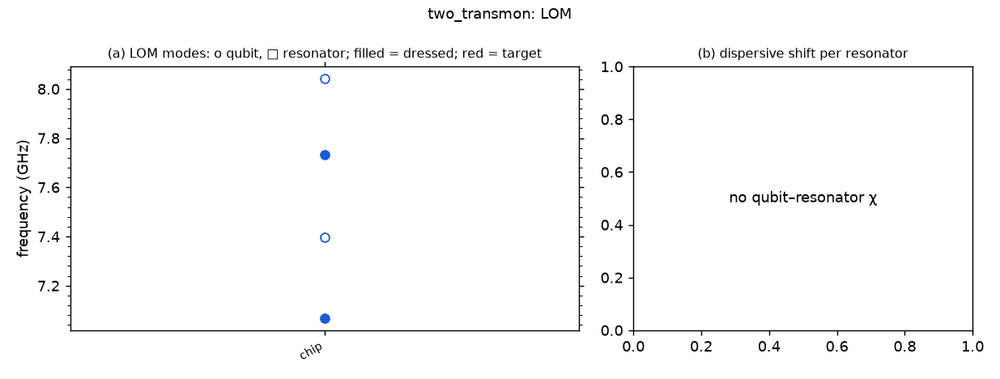
These are lumped-model estimates from component formulas and calibration, not FEM results. The LOM page says how far to trust them.
Build spec
The rest of this page is the detailed spec the notebook was built from: every component, port, route and length.
The
metal:references in this spec build as written, through themetal:wrapper (ports are the Metal pin names, parameters the Metal options).metal:TransmonPocketbuilds this chip. The Quantcore and KQC substitutions are optional.
Source: doc-sphinx/source/examples/two_transmon.ipynb · licence Apache-2.0 (LICENSE, verified) · read on 2026-11-02. The notebook
has no stored outputs. Quantum Metal design, SQDMetal Palace eigenmode (2 modes from 5 GHz), silicon.
What it is: two floating pocket transmons 1 mm apart. Their facing connection pads are joined by a straight CPW, so
the coupling is a direct capacitive link with no resonator. It is a minimal 2-qubit EPR / eigenmode test.
Frame: Metal chip 2.2 × 1.8 mm centred at (0.5, 0) mm, substrate 500 µm (size_z −500 µm). Box (0, 0, 2200, 1800),
Designer = source + (600, 900). CPW: Metal defaults (cpw_width 10, cpw_gap 6).
The chip uses metal:TransmonPocket. A geometry-only stand-in is KQC DoublePads.
Components
instance |
catalog ref |
key params (units) |
at (x, y) Designer |
rot |
notes |
|---|---|---|---|---|---|
Q1 |
|
pad_width 425, pocket_height 650; other Metal defaults: pad_height 90, pad_gap 30, pocket_width 650. Connection pad |
(600, 900) |
0 |
source (0, 0) |
Q2 |
same |
same, |
(1600, 900) |
0 |
source (1000, 0) |
Junctions (Palace lumped ports): Q1 L_J 13 nH, Q2 L_J 9 nH, C_J 0, so junction={"Lj_nH": 13, "Cj_fF": 0} and
{"Lj_nH": 9, "Cj_fF": 0}.
Routes
route |
from → to |
type, length |
notes |
|---|---|---|---|
COUPLER |
Q1.readout → Q2.readout |
cpw straight ( |
≈ 1000 − 2·(325 + cpw_extend) µm. Galvanically joins the two connector pads |
With the DoublePads stand-in, cplr sits at the top centre, not at the top corner. Route Q1.cplr → Q2.cplr with
nodes above the pockets, or rotate the qubits ±90° so the couplers face each other.
Launchers, pads, test structures, markers, labels
None (eigenmode model only).
LOM node structure
Q1, Q2: floating two-island transmons (two pad nodes each, JJ between them). Each has one connector pad with C to one island. The connector pads plus the CPW form one shared coupler node, giving Q1–Q2 coupling through C_c1 and C_c2 in series via that node. No resonators, feedlines or control lines.
Targets
None stated. The detuning comes from Lj 13 vs 9 nH (eigenmodes searched from 5 GHz).
Simplifications for a first rebuild
DoublePads(island extents [425, 90], island_island_gap 30, ground_gap [650, 650]) with rot 90/270 socplrfaces the other qubit. The LOM for DoublePads is not implemented yet.
Build
The notebook uses metal:TransmonPocket (the Metal cell itself, not the DoublePads stand-in); coupler route r = 20 µm (the two pins are 150 µm apart).
Quantcore PDK rebuild
The notebook is a Quantcore PDK rebuild of the source, not a replica: the netlist, LOM and imported components are kept, and the process is Quantcore’s.
Notebook: examples/designs/sqdmetal/two_transmon.ipynb.
Chip: the Quantcore die frame (L dicing markers 1000/0, 3 × 3 alignment grids 1001/0, chip boundary 100/0, device ID where an edge is free; any brand text is QCT), on the 7.5 × 7.5 mm Quantcore die; the source’s 2.2 × 1.8 mm chip area is centred in it (
box=(-2650, -2850, 4850, 4650)), so every coordinate stays the source’s.Stack: sapphire 650 µm, εr 10.25 (the PDK default stack, used by the LOM estimates and every FEM export); the SQDMetal examples are on silicon (280–500 µm), so frequencies differ from the source’s.
Junctions: Quantcore Nb/AlOx/Nb trilayer junctions (
junction_typefromlayouts.registry.trilayer_junction): fingers on 2/0 + 4/0, spacer 50/0 with the 51–53/0 gradient, sized on the PDK junction rule (Nb Δ = 1.4 meV, I_c·R_n = πΔ/2e, R_n·A 13.5 kΩ·µm² and C_J 50 fF/µm² assumed). The source detunes the pair with its Palace junctions (13 / 9 nH); the rebuild keeps that order at the two ends of the 40–50 kΩ window: Q1 R_n 50 kΩ (L_J ≈ 7.5 nH, C_J ≈ 13.5 fF), Q2 40 kΩ (≈ 6.0 nH, ≈ 16.8 fF). Expected f_q ≈ 7.0 / 7.8 GHz (estimates).Kept: the topology (two floating pockets, a straight coupler), the Metal components with the source’s options and positions, the sim group.